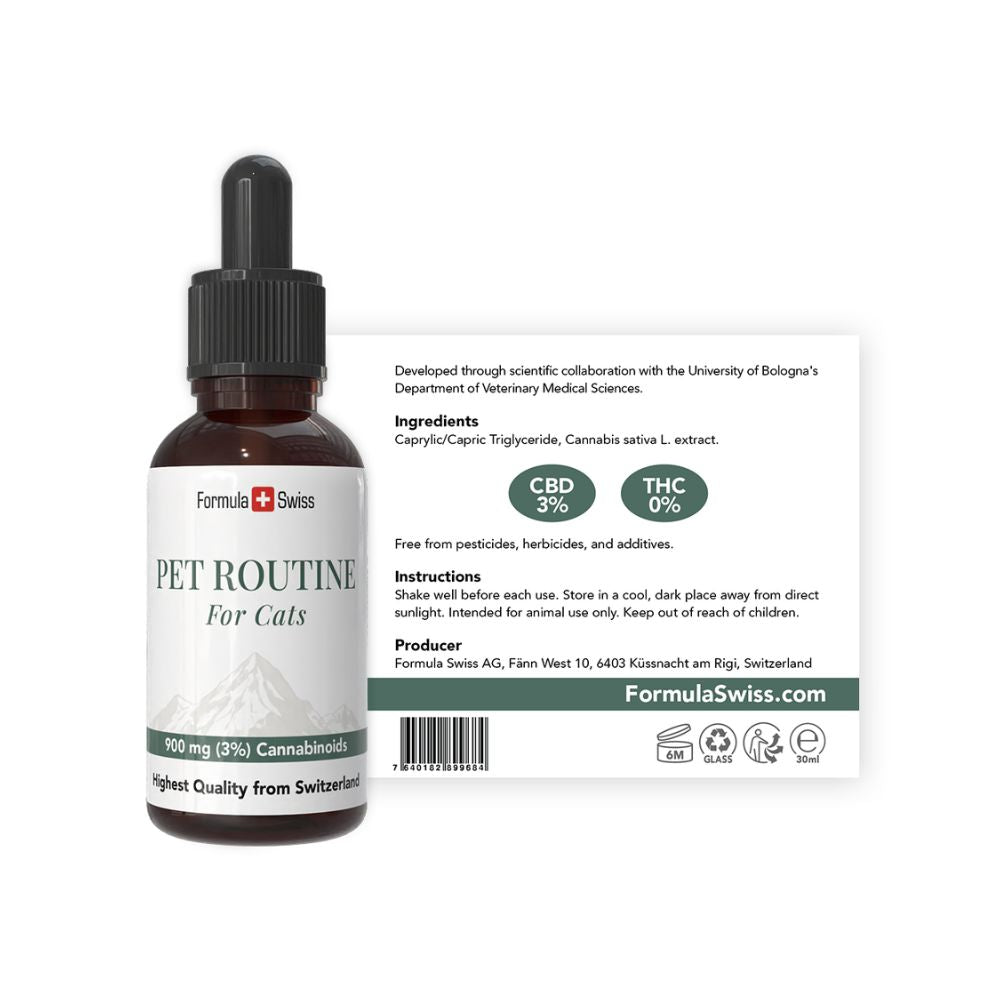

























Pet Routine for Cats
3% CBD Oil · 30 ml · 2026 formula
Made in Switzerland from hemp grown following organic principles, with an MCT carrier oil. A vegan formula with 0% THC, backed by more than 10 years of Formula Swiss CBD experience.
Pet Routine for Cats
- Made in Switzerland since 2013
- Hemp grown to organic principles
- Vegan
- 2026 formula
- 0% THC
Couldn't load pickup availability
Buy more, save more
Description
Description
Pet Routine for Cats is a CBD oil for cats with 3% CBD in MCT oil, in a 30 ml bottle. It contains 900 mg CBD and has a 0% THC specification.
The oil is for external use: shake well, apply the drops to your cat’s skin and follow the directions on the label. Ask your veterinarian about suitability, especially if your cat takes medicines.
Made in Switzerland from hemp grown in Switzerland following organic principles, with CO2 extraction. Every production batch is tested. The batch number is printed on the label: find the certificates of analysis on our test results page, or send us the batch number and we will find the report for your bottle.
Ingredients & formula
Ingredients & formula
| Cannabinoid | Concentration | Per bottle |
|---|---|---|
| CBD | 3% | 900 mg |
Labelled formula values, not individual laboratory measurements. Carrier: MCT oil (Caprylic/Capric Triglyceride). THC specification: 0%. See Testing & certifications for the laboratory report.
How to use & important information
How to use & important information
Apply the drops to your pet’s skin as described on the label. Ask your veterinarian if you are unsure.
Pet Routine for Cats is not a registered veterinary medicine.
Storage & shelf life
Storage & shelf life
Storage
Shelf life
Testing & certifications
Testing & certifications
Produced in Switzerland
What cat owners say about our CBD oils
See all Formula Swiss reviews (opens in a new window)Selected customer experiences with our CBD oils for cats, including earlier formulas. Excerpts are marked and link to the full reviews. These are personal experiences, not clinical evidence for this 2026 formula.
-
Read original review (opens in a new window)Great product. Has helped my cat with his arthritis.
-
He is a different cat now. More like a kitten enjoying life and so playful.
Excerpt
Read original review (opens in a new window) -
The drops I get from Formula Swiss have really helped my cat to calm down and have a better quality of life.
Excerpt
Read original review (opens in a new window) -
From the skin care to the drops; even my cats absolutely love it.
Excerpt
Read original review (opens in a new window)

CBD for cats: our university research and other published studies
These selected publications cover feline receptor biology, CBD tolerability and clinical research. None tested Pet Routine for Cats or establishes that this oil treats disease. Research preparations and routes of administration differ from this product.
For dosage, safety and what the cat studies show, read our guide to CBD for cats.
Formula Swiss-funded university research
Our research at the University of Bologna
From 2019 to 2021, Formula Swiss funded Professor Roberto Chiocchetti's research at the University of Bologna. His team mapped cannabinoid receptors in the mouth, stomach and intestines of cats. Both publications acknowledge Formula Swiss funding.
Read the university project record (opens in a new window)-
Tissue research
Cannabinoid receptors in the feline digestive tract (opens in a new window)
Mapped where cannabinoids may act in the feline gut.
- What they did
- Researchers examined cannabinoid and related receptors in feline stomach and intestinal tissue.
- What happened
- Researchers mapped cannabinoid and related receptors in feline digestive tissues.
- Good to know
- Anatomical evidence; no CBD product treatment, effectiveness or dosage was tested.
Stanzani et al. · Histochemistry and Cell Biology · 2020
-
Tissue research
Cannabinoid receptors in the mouths of healthy cats and cats with gingivostomatitis (opens in a new window)
Receptor levels differed in healthy and inflamed mouth tissue.
- What they did
- Researchers compared mouth tissue from 16 healthy cats and cats with chronic gingivostomatitis.
- What happened
- Found cannabinoid and related receptors in the lining of the mouth, with markedly higher levels in cats with chronic gingivostomatitis, a painful inflammation of the mouth.
- Good to know
- Tissue samples from 16 cats; no CBD product treatment, effectiveness or dosage was tested.
Polidoro et al. · Journal of Feline Medicine and Surgery · 2020
What other CBD studies in cats found
Eleven selected publications, grouped by topic. Early findings are promising in some settings, but small studies and different preparations limit what we can conclude. A placebo is a dummy oil or paste without the active cannabinoids, used for comparison.
Mouth and joint pain
2 studies
-
Partly positive
CBD alongside standard treatment for feline gingivostomatitis (opens in a new window)
A disease activity score improved more with CBD.
- What they did
- Twenty-two cats received CBD powder or placebo for 15 days around dental extraction, alongside standard pain treatment.
- What happened
- Cats given CBD for 15 days, starting just before tooth extraction, improved significantly more on a disease activity score than cats given placebo. Pain scores also fell further, but that difference was not statistically significant.
- Good to know
- Twenty-two cats; CBD was one part of a treatment that included tooth extraction and pain relief, and the results apply to the tested CBD powder.
Coelho et al. · Animals · 2023
-
Positive result
CBD and CBDA hemp paste for cats with osteoarthritis pain (opens in a new window)
Pain scores improved among cats completing the trial.
- What they did
- Twenty-six cats with osteoarthritis entered a blinded crossover trial comparing six weeks of CBD/CBDA paste with placebo.
- What happened
- Pain scores recorded by veterinarians and by owners fell significantly after six weeks of the paste, and blood chemistry did not differ from placebo.
- Good to know
- Only 14 of 26 cats completed the study, mostly because they refused the paste, and some vomited. The paste's manufacturer funded the study.
Mulder et al. · Journal of Feline Medicine and Surgery · 2025
Handling and veterinary procedures
3 studies
-
Partly positive
CBD before spaying surgery in cats (opens in a new window)
Less rescue pain relief was needed during surgery.
- What they did
- Twenty-two cats received CBD or dummy oil before spaying, in addition to their usual anaesthesia and pain management.
- What happened
- None of the cats given CBD needed extra pain relief during the operation, compared with four of ten given placebo, and they were more sedated before surgery. Pain after surgery was largely similar.
- Good to know
- Twenty-two cats and one dose before surgery; all cats still needed morphine afterwards.
Zanelli et al. · Animals · 2024
-
Early finding
CBD oil and anaesthetic requirements in cats (opens in a new window)
Anaesthetic requirements fell in this small study.
- What they did
- Researchers measured anaesthetic requirements in 16 healthy cats before and after a single CBD dose.
- What happened
- A single dose of CBD oil reduced the amount of inhaled anaesthetic cats needed by 11%. Heart and breathing rates were higher at the time of measurement.
- Good to know
- Sixteen healthy cats, one dose given by stomach tube and no placebo group.
Suriyawongpongsa et al. · Animals · 2025
-
Early finding
A single dose of CBD oil and handling in healthy cats (opens in a new window)
Cats resisted handling less after CBD.
- What they did
- Nine healthy cats were assessed for sedation, handling response and pain sensitivity after one dose of CBD oil.
- What happened
- Cats were mildly sedated and resisted handling less two to four hours after CBD, while pain sensitivity, heart rate and breathing did not change.
- Good to know
- Nine healthy cats and a single, relatively high dose; without a placebo group, other influences cannot be ruled out.
Wanapinit et al. · Animals · 2025
CBD absorption and tolerability
6 studies
-
Safety study
CBD-rich hemp: absorption and preliminary safety in dogs and cats (opens in a new window)
Cats absorbed CBD differently from dogs.
- What they did
- Researchers measured absorption after a CBD-rich hemp oil and monitored eight healthy cats during 12 weeks of use.
- What happened
- CBD exposure was lower in cats than in dogs. Cats sometimes licked or shook their heads after dosing; one had a persistent elevation in a liver enzyme.
- Good to know
- Small healthy-animal study; not evidence of effectiveness for a disease. Do not assume equivalent responses across species.
Deabold et al. · Animals · 2019
-
Safety study
Escalating cannabinoid doses in healthy cats (opens in a new window)
The oil composition affected tolerability.
- What they did
- Twenty healthy cats received escalating doses of CBD, THC, combined oils or a dummy oil under blinded monitoring.
- What happened
- No clinically significant blood-test changes were found. Mild temporary side effects occurred; neurological signs were more common with THC-containing oils.
- Good to know
- Twenty cats across five groups; mild adverse events occurred. Findings depend on the tested oils and do not establish routine doses.
Kulpa et al. · Journal of Feline Medicine and Surgery · 2021
-
Safety study
Absorption of a CBD and CBDA hemp paste in cats over one week (opens in a new window)
The paste was absorbed and tolerated during a short trial.
- What they did
- Eight healthy cats received a CBD/CBDA-rich paste. Researchers measured blood concentrations and monitored one week of twice-daily use.
- What happened
- Cats absorbed the cannabinoids from the paste, and a week of twice-daily use caused no behavioural or neurological side effects or clinically relevant changes in blood tests.
- Good to know
- Eight healthy cats for one week, with no placebo group. The paste's manufacturer funded the study.
Wang et al. · Frontiers in Veterinary Science · 2022
-
Safety study
Escalating single doses of CBD in healthy cats (opens in a new window)
Higher doses produced higher CBD blood levels.
- What they did
- Eight healthy cats received different single oral doses of purified CBD, separated by washout periods.
- What happened
- Single doses of up to 80 mg per kg of body weight were well tolerated; reactions were limited to head shaking, lip smacking and drooling just after dosing.
- Good to know
- Eight research cats and single doses only; this does not show that repeated use is safe or indicate a dose to give.
Rozental et al. · Journal of Veterinary Pharmacology and Therapeutics · 2023
-
Safety study
CBD absorption in cats with and without food (opens in a new window)
Food substantially changed CBD absorption.
- What they did
- Nine healthy cats received a single dose of a purified CBD medicine, both after food and while fasting in a crossover study.
- What happened
- Cats absorbed about eleven times more CBD when it was given after a meal than on an empty stomach.
- Good to know
- Nine healthy cats given one dose of a purified CBD medicine; effects on health were not studied.
Jukier et al. · Frontiers in Veterinary Science · 2023
-
Safety study
Long-term daily cannabidiol feeding in healthy cats (opens in a new window)
Longer-term use was monitored, with important limits.
- What they did
- Randomised, blinded trials compared daily CBD with a dummy oil, including a 26-week study in healthy cats.
- What happened
- The tested CBD distillate was generally tolerated over 26 weeks among cats completing the trial. Blood-test results were broadly comparable with placebo.
- Good to know
- Healthy cats and one tested distillate only. Two CBD-treated cats had raised liver enzymes during the shorter study and did not enter the 26-week trial. Monitoring remains important; the results do not prove disease benefits.
Coltherd et al. · Frontiers in Veterinary Science · 2024